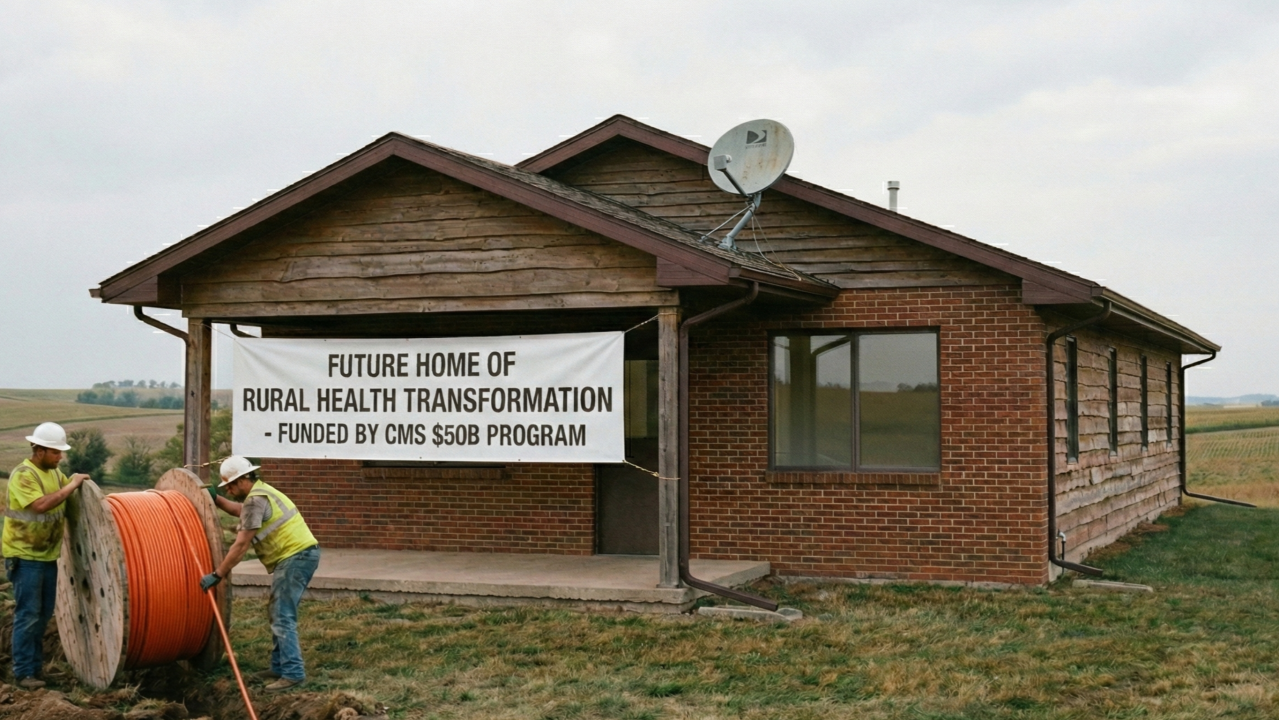
Breaking: CMS drops $50B for Rural Health (and what it means for Tech)
Just as we were closing the books on 2025, the Centers for Medicare & Medicaid Services(CMS) made a historic announcement that fundamentally shifts the landscape for the coming year. Yesterday, they unveiled the $50 Billion Rural Health Transformation Program.
In my article earlier this month, 2025 Was a Year of Correction, 2026 Will Be the Year of Construction, I predicted that the industry would be forced to pivot from flashy AI pilots to serious infrastructure building.
I did not expect the federal government to prove me right this quickly!! :)
This new program is the largest single investment in rural healthcare infrastructure since the Hill-Burton Act. For health tech leaders, founders, and clinicians, this is not just a policy update. It is a signal that the market for 2026 will be defined by those who can solve the "last mile" problem in healthcare delivery.
The News: What CMS Announced
Late Monday afternoon, CMS Administrator Dr. Mehmet Oz announced the finalized rule and funding allocation for the Rural Health Transformation Program (RHTP). The program earmarks $50 billion over the next five years.
Crucially, the funding is distributed via block grants with a 50/50 split formula: 50% is distributed equally among states to ensure a baseline, while the remaining 50% is allocated based on specific rurality and need metrics.
Here are the three mandates that directly impact the technology sector:
1. The "Digital Infrastructure" Mandate While there is no hard cap, the rule mandates that states must allocate a significant portion of their grant specifically to "Digital Infrastructure Modernization" to qualify for the full award. This effectively unlocks billions for hardware and connectivity upgrades at Critical Access Hospitals (CAHs). As I noted in my "Construction" piece, you cannot run 2026 software on 2015 hardware. This funding finally addresses that technical debt.
2. Telehealth Parity Permanency The program codifies the "hospital at home" waivers that were set to expire this week, making reimbursement for rural remote monitoring permanent at the facility rate. This removes the "regulatory overhang" that has kept many investors on the sidelines regarding rural telehealth.
3. The "Tech-First" Workforce Grant A dedicated portion of the fund is reserved for training rural clinicians on advanced diagnostic tools. The rule specifically rewards systems that implement AI-assisted triage to extend the reach of limited staff.
You can verify the allocation formula and "allowable use" definitions here CMS Press Release: CMS Announces $50 Billion in Awards to Strengthen Rural Health.
Why This Matters Now
We have spent much of 2025 discussing the potential of Agentic AI and predictive analytics. However, the adoption of these tools has been uneven. While academic medical centers are piloting fully autonomous coding agents, hospitals in rural America are often struggling to keep their Wi-Fi running during storms.
This funding bridges that gap.
It acknowledges that high-tech software cannot function without high-tech infrastructure. By subsidizing the hardware and connectivity layer, CMS is effectively building the highway that our health tech vehicles need to drive on. This validates the "Construction" thesis entirely. We are done correcting the over-hype of previous years. We are now pouring the concrete for the next decade of digital health.
The Opportunity for Startups and Innovators
For the founders and product leaders reading this, the RHTP changes the calculus for your 2026 Go-To-Market strategy. The "Blue Ocean" is no longer in optimizing billing for urban centers. It is in bringing parity to rural zip codes.
1. Pivot to "Hybrid" Hardware Pure software plays have struggled in rural markets due to hardware incompatibility. This funding opens a massive procurement cycle for improved diagnostic devices. If your software can integrate directly with the new wave of CMS-subsidized connected devices (digital stethoscopes, handheld ultrasounds, remote vitals monitors), you have a distinct advantage.
2. Focus on Workflow, Not Just Diagnosis The "Tech-First" workforce grants are designed to combat burnout. Rural systems do not just need better diagnostics. They need tools that reduce administrative burden. The winners in this space will be platforms that automate scheduling, billing, and triage. This empowers the limited number of physicians and nurses to focus entirely on patient care rather than paperwork.
3. The Rise of Asynchronous Care With the new reimbursement rules for remote monitoring, asynchronous telemedicine (store-and-forward) becomes a viable business model for rural areas. Patients in remote locations can upload data or images which are reviewed later by a specialist. This model respects the time constraints of both the patient and the provider.
Dr. Matt’s Take: Empowerment Through Access
I want to be clear about what this means for our profession.
For too long, we have accepted a two-tier system where cutting-edge technology was reserved for high-volume urban centers. We assumed that rural healthcare had to be "low tech" by necessity. This investment challenges that assumption.
This is about empowerment.
It empowers the rural family physician to consult with world-class specialists in real time without the connection dropping.
It empowers the patient living three hours from a hospital to receive hospital-level monitoring in their own living room.
It empowers the health tech industry to look beyond the saturated urban markets and build solutions for the communities that arguably need them the most.
What You Should Do This Week
If you are leading a health tech organization, I recommend three immediate actions:
- Review the State-Level Allocation: Since 50% of the funds are need-based, you need to know which states are receiving the largest injections of capital. Look up the specific allocation for your target markets here
HHS: Rural Health Transformation State Allocation Map.
- Audit Your Bandwidth Requirements: Can your platform run on the improved but still variable connections found in rural areas? If you require 5G speeds for your app to function, you may miss the initial wave of adoption.
- Reach Out to Rural Partners: Do not wait for the RFP. Connect with rural hospital administrators now. Ask them how they plan to utilize the RHTP funds and offer to help them draft the technical requirements for their "modernization plans."
Looking Ahead to 2026
We are entering 2026 with a clear directive. The resources are there. The policy is set. The technology is ready.
The question for the next twelve months is execution. Can we take this capital and translate it into meaningful outcomes? Can we build tools that actually work for the doctor in Wyoming as well as they do for the doctor in New York?
I believe we can.
Happy New Year. Let’s get to work.
— Dr. Matt